Airport Energy Management
How Düsseldorf Airport Cuts 6,000 Tonnes of CO₂ a Year with Predictive Control


Nov 10, 2026
Dr. Jennifer Fest
Head of Communication & Marketing
Case Study
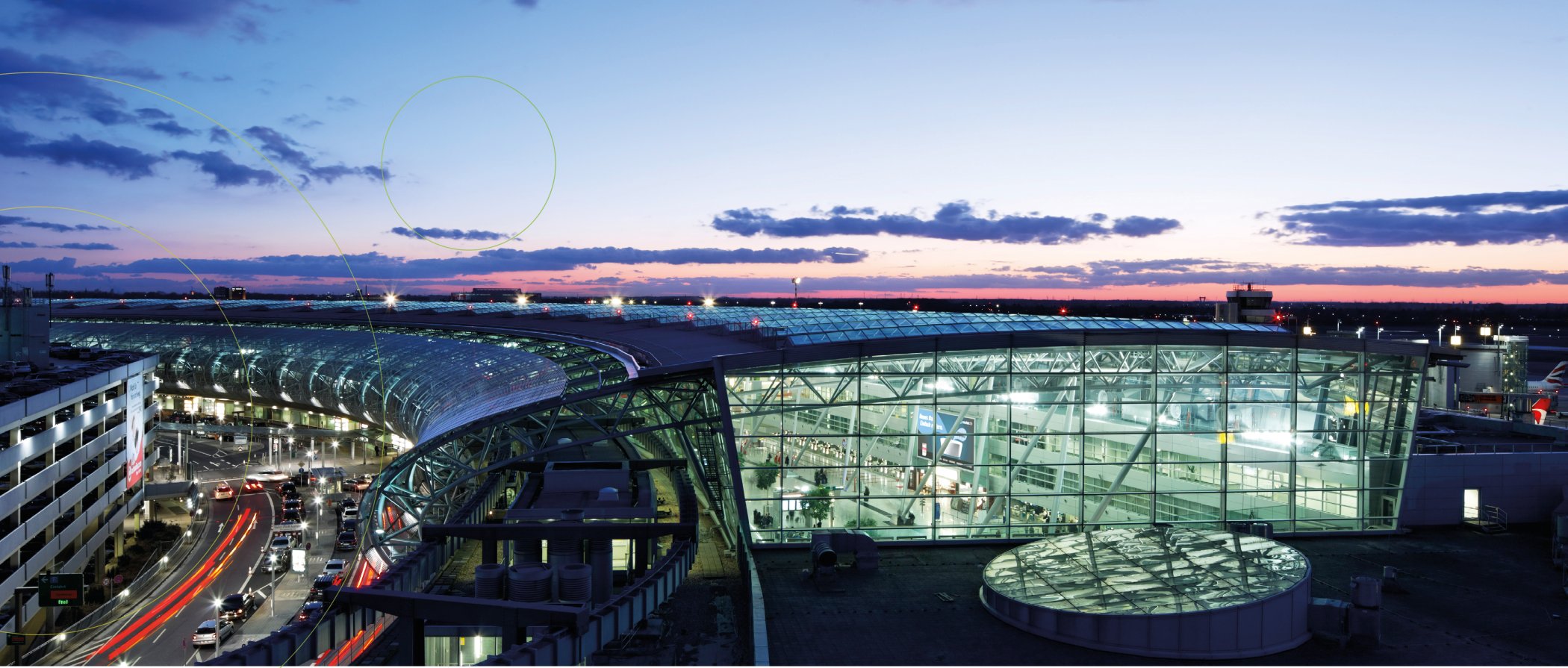
An airport never sleeps. Terminals, gates, offices: heating, cooling, ventilation and energy supply have to run reliably around the clock for thousands of passengers and staff. Even so, Düsseldorf Airport (DUS) has set itself an ambitious target: climate-neutral operations across the entire site by 2035. meteoviva, the Aachen-based provider of predictive building control, has been part of that journey for more than a decade.
Few building types are as demanding as an airport. Occupancy rises and falls with the time of day, the day of the week and the flight schedule. Vast glass façades let in large amounts of solar heat, and open halls are notoriously hard to keep at a comfortable temperature. Many building systems in different buildings have to work together. And operations can never stop, so major retrofits are hardly an option in day-to-day airport life.
That is exactly what makes Düsseldorf Airport such a compelling example of what digital, minimally invasive optimisation can achieve.
The partnership began in 2012 with the Central East Building. After those first results, more buildings were added over time. Today, meteoviva technology is in use in 13 buildings across the airport, including all three terminals. In total, around 430,000 m² of floor space is now actively controlled.
Predictive building control means that heating, cooling and ventilation are adjusted in advance, based on forecasts of what a building will need, rather than in response to conditions that have already occurred. Conventional building automation only reacts once a space is already too warm or too cold.
With mv climate, each building is modelled as a digital twin that combines weather forecasts, building physics, building systems, and climate and usage profiles. From this, the solution simulates the optimal way to run the building over the hours ahead. AI-supported processes then feed the optimised setpoints back into the building, which in turn reports its actual measured values. The model keeps learning all the time.
The result: energy is used exactly when it is needed, not after the indoor climate has already drifted off course.
Demand side management (DSM) means adapting when and how a building consumes energy to signals from the energy system, such as electricity prices, grid load or the share of renewables. Instead of drawing power whenever it is needed, the building shifts its demand to the most favourable times.
At Düsseldorf Airport, the advanced building technology allows many buildings not only to be actively controlled but also to be operated in a grid-friendly way. This is where mv sync, meteoviva’s demand side management solution, comes in. mv sync builds on predictive control and adds load and consumption forecasts, grid signals and electricity prices to the equation. These are balanced against the airport’s own heating, cooling and power generation. As a result, affordable and sustainable energy is prioritised, and supply-side systems are run optimally in terms of cost, efficiency, CO₂ emissions and availability. Self-generated solar power, for example, can be consumed on site to the greatest possible extent. The airport’s buildings and networks also act as storage for thermal energy, a flexibility that is becoming increasingly valuable in the energy system of the future.
The combination of mv climate and mv sync delivers measurable impact:
Düsseldorf Airport shows that climate action in existing buildings doesn’t have to mean a major construction project. These savings were achieved without structural changes, during live operations and using the building systems already in place. If it works at one of the most complex building sites there is, it can work for office buildings, shopping centres, universities and public buildings, too. Another airport example is THE SQUAIRE at Frankfurt Airport, Germany’s largest office building, which also runs on meteoviva technology.
How much energy does Düsseldorf Airport save with meteoviva?
Düsseldorf Airport saves approximately 14,800 MWh of energy per year, which corresponds to a 20% reduction in energy consumption and around 6,000 tonnes of CO₂ avoided annually.
Do buildings need structural changes for predictive control?
No. meteoviva’s solutions connect to the existing building automation and use the technical systems already in place. Only minimal on-site hardware is needed, which is why the approach also works during live operations.
What is the difference between mv climate and mv sync?
mv climate controls the heating, cooling and ventilation of individual buildings predictively, based on a digital twin. mv sync builds on this and adds demand side management: it aligns energy consumption with electricity prices, grid signals and on-site generation.
Which buildings is predictive building control suitable for?
It is suitable for a wide range of non-residential buildings, including offices, shopping centres, universities, public buildings and airports. Because no structural changes are required, it also works for listed buildings.
Curious about the potential hidden in your buildings? Get in touch with us. You can read the full Düsseldorf Airport case study here.
Düsseldorf Airport: Predictive Energy Management | meteoviva
Düsseldorf Airport saves 14,800 MWh and 6,000 t CO₂ a year with predictive building control and demand side management from meteoviva.
meteoviva and SAUTER present meteoviva ready
meteoviva and SAUTER Deutschland are strengthening their strategic partnership through their ‘meteoviva ready’ approach, with the aim of seamlessly integrating meteoviva’s digital solutions with SAUTER’s building automation systems.
Saving energy is just the start 5 ways your building can save you money
Reducing energy consumption is the most obvious way to improve building efficiency, but it is by no means the only one. We highlight five areas where savings can be made and explain which types of buildings stand to benefit the most.
Solar eclipse, energy prices & the effects of demand side management
A solar eclipse caused electricity prices to peak last night. Find out how demand-side management will make buildings independent of such price spikes in future.