Solar eclipse, energy prices & the effects of demand side management
What a solar eclipse has to do with your electricity bill


August 13, 2026
Dr. Jennifer Fest
Head of Communication & Marketing
Deep Dive
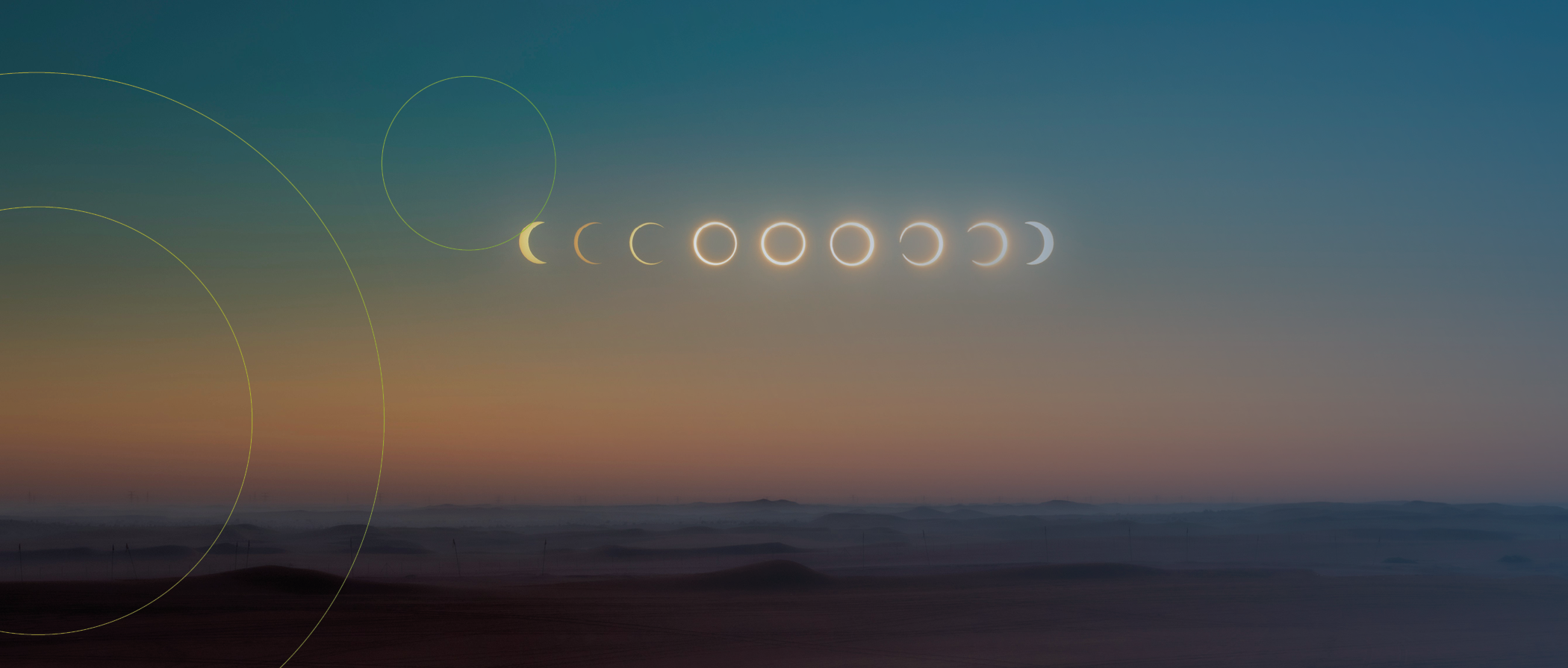
Last night, the moon passed in front of the sun across large parts of Germany, causing a partial solar eclipse. Astronomically speaking, this was of course a remarkable, though fairly short spectacle. Its impact on the electricity market lasted considerably longer.
Prices on the EPEX Spot electricity exchange rose to many times their usual level: between 7 pm and 7.15 pm, wholesale electricity was already costing 210 € per megawatt-hour, and between 7.45 pm and 8 pm, as much as 460 €. Of course, the sun is generally lower in the sky in the evening, which is why the difference in feed-in compared to ‘normal conditions’ (i.e. a day without a solar eclipse) was not actually that massive in itself. However, combined with the relative lack of wind observed yesterday, the effect was significant (for more precise data, see e.g. the Energy-Chart by Fraunhofer ISE or Smard.de by the government).
There was never any risk of a supply shortage, nor was there any realistic threat of a crisis. The situation merely highlighted a mechanism that can be observed regularly on the electricity exchange anyway. Whenever weather conditions mean that less solar and/or wind power is available, whilst demand remains the same or even rises, prices go up.
It is precisely this mechanism that forms the basis for demand-side management. It has long been clear that such price spikes occur, and the only logical response is to manage one’s own consumption in such a way as to become independent of these fluctuations.
An extreme example of a regular pattern
The solar eclipse was an extreme case because it was precisely predictable and took place over a short period of time. However, the underlying pattern is absolutely commonplace. Whenever electricity sources such as wind and solar are supplying little power, but consumption remains consistently high, a shortfall arises that must be offset by more expensive generation. This drives the price up, regardless of whether the trigger is a weather condition, less daylight in winter or, indeed, an astronomical event.
On a smaller scale, we see this effect every day; it simply follows the logic of supply and demand. On a perfectly ordinary summer’s day, when the sun is high in the sky at midday, the electricity price can temporarily drop to near zero due to high solar generation. As soon as the sun begins to set in the early evening, whilst at the same time many households increase their consumption after work, the price rises again.
This is not a sign that there is anything wrong with renewable energy, but simply the consequence of the fact that solar and wind power are weather-dependent. Historically, however, our electricity system was designed so that the sources – coal, natural gas, etc. – could be used as and when required. Electricity generation therefore adapts flexibly to largely fixed consumption. The bigger the share of renewable energy, the greater the shift in this balance, and the more important the question becomes of how these fluctuations on the consumption side can be cushioned.
Our system as a one-directional process
For decades, our electricity grid was built around a simple principle: consumption is more or less fixed, and generation must be tailored to it. Power stations were ramped up or down depending on how much electricity was needed at any given time. This posed no problem, as the relevant energy sources could be stored and used as required. Consumption itself remained essentially unaffected ; nobody had to wonder when it was best to switch on the washing machine, ramp up production or charge their electric car.
With the growing share of wind and solar power, this logic no longer works smoothly. Generation cannot simply be scaled up or down as required, as it is dependent on the weather. When consumption and generation are out of sync, as was the case on Wednesday evening during the solar eclipse, the gap is filled by more expensive reserve power stations, which is then a cause of such price spikes.
The solution to avoiding such price rises, or at least not being dependent on them, is quite obvious. If generation fluctuates depending on the weather, consumption should be adjusted more closely to it. This is precisely the basic idea behind demand-side management.
Consumption as a control lever
dsm therefore turns the traditional principle on its head. It is not generation that adapts to consumption, but consumption that adapts to generation. That sounds simple, but historical structures are often deeply entrenched, and this requires a fundamental shift in mindset and approach.
What does this mean in practical terms? To adapt to generation, we must, for example, deliberately shift our consumption to the hours when plenty of electricity is available and cheap, whilst reducing it when it becomes scarce and expensive. A few examples illustrate how this works in practice.
Controlling all of this manually is, of course, impractical, particularly on an industrial scale. dsm is therefore based on a system that recognises when electricity is cheap and automatically controls consumption accordingly.
Back to the solar eclipse: regardless of the price spike
Back to Wednesday evening. It was precisely during this window that dsm would have demonstrated its full potential.
A household or business without load management simply has to cope with the price spike. The heat pump carries on heating, the electric car carries on charging, and production carries on, regardless of whether a kilowatt-hour currently costs 30 cents or 46 cents.
Things would have been different with dsm. The system works proactively, so it adjusts everything in advance to ensure you get the best possible start. The heat pump would have preheated a little more – if necessary – before 7 pm. The electric car would have paused the charging process for those two critical hours and charged before or after them instead. All flexible processes would therefore have been shifted to the cheaper time slots. Particularly in industry, where large amounts of energy are consumed, this approach can lead to enormous savings.
Who stands to benefit from dsm?
dsm is worthwhile first and foremost for those who use it. Those who shift their consumption pay less. That is the immediate benefit.
However, the long-term effect goes beyond that. The more consumers make their demand flexible and ‘adaptable’, the fewer peaks there are in the first place. And fewer peaks, in turn, mean less need for reserves during off-peak periods. Ultimately, this takes the strain off the entire system, not just the individual connection.
An overview of some of the effects:
dsm is therefore not merely a cost-optimisation tool for individual buildings or businesses, but a building block that facilitates the seamless integration of wind and solar power into the electricity system, offering benefits for everyone.
Conclusion
A solar eclipse is a rare event. The price spikes it triggered, however, occur all the time – even today – though usually more inconspicuously and without making the headlines.
dsm is therefore no longer a niche product or a vision of the future. Nor is it a one-off response to a rare celestial event. dsm is a structural response to an electricity system that is currently undergoing fundamental change. Those who manage their consumption flexibly are immediately less dependent on price spikes and more resilient to outages, and make their portfolio fit for the future.
meteoviva and SAUTER present meteoviva ready
meteoviva and SAUTER Deutschland are strengthening their strategic partnership through their ‘meteoviva ready’ approach, with the aim of seamlessly integrating meteoviva’s digital solutions with SAUTER’s building automation systems.
Saving energy is just the start 5 ways your building can save you money
Reducing energy consumption is the most obvious way to improve building efficiency, but it is by no means the only one. We highlight five areas where savings can be made and explain which types of buildings stand to benefit the most.
Solar eclipse, energy prices & the effects of demand side management
A solar eclipse caused electricity prices to peak last night. Find out how demand-side management will make buildings independent of such price spikes in future.
ISO/IEC 27001:2022: Information Security Standard
TÜV Rheinland has once again certified meteoviva to ISO/IEC 27001:2022. Find out exactly what this means for the security of your data and for working with us.